AI development tools like Claude Code have popularised "vibe coding," allowing engineers to generate custom software directly from natural language prompts. For energy executives, the promise of building bespoke software rapidly without taking on rigid vendor contracts sounds like an ideal solution.
However, internal build programs quickly hit an operational ceiling:
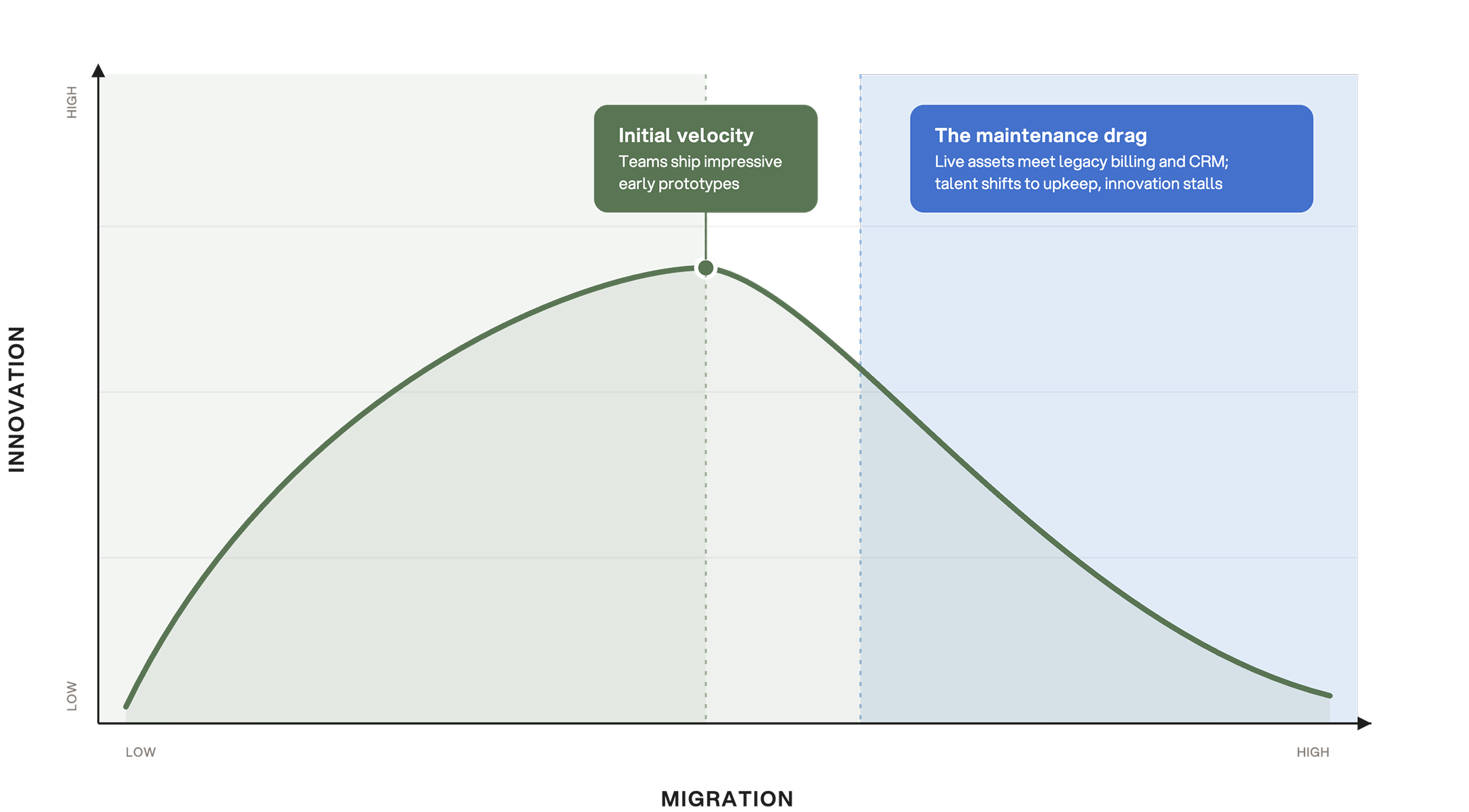
- Initial Velocity: Teams quickly build impressive early prototypes.
- Operational Complexity: Friction hits when connecting live assets - EVs, solar, smart meters - to legacy billing and CRM platforms.
- The Maintenance Drag: Innovation stalls as scarce developer talent shifts from creating new products to maintaining underlying code. Gartner reports that only 15% of enterprise AI projects ever reach full production.
In an industry that is highly regulated and that every family and business counts on to provide affordable, reliable energy, there is no margin for error. While AI accelerates early code creation, it struggles with complex edge cases, continuous interoperability, and enterprise-grade resilience.
Navigating Data Ownership and Governance in the AI Era
Engineering teams naturally want to build in-house data layers and custom agentic workflows to gain direct control over their software stack. However, as AI systems begin taking real-time actions on behalf of customers (such as automating billing queries or executing smart charging schedules based on market prices), the core challenge quickly shifts from initial build velocity to long-term operational accountability.
Attempting to build modern AI tools on top of disparate legacy systems, reconciling siloed CIS, CRM, and billing data, is infinitely more complicated than starting with a single, clean data layer. Building custom software infrastructure rarely creates a lasting competitive advantage when AI tools are democratising code creation across the market.
"If what you thought was your moat is no longer a moat, then what actually becomes your differentiator if it's not the technology?"

Carol Yan
General Manager, Energy & Utilities UKI, AWS
Attempting to build and maintain the security, ISO compliance, and audit trails required for energy retail diverts vital engineering talent away from true customer differentiation. Rather than creating a durable moat, internal teams end up spending most of their time managing complex data pipelines, integration breaks, and regulatory audit cycles.
The Unseen Costs of Building for AI and Electrification
Orchestrating modern electrification (including EV chargers, heat pumps, solar, and battery storage) presents a massive high-frequency asset integration challenge. Internal builds must constantly adapt to evolving market protocols, hardware standards, and unpredictable AI token spend, leaving engineering teams stuck rewriting integrations rather than shipping customer value.
Specialised platforms, by contrast, leverage scale to embed modern AI tooling directly into core infrastructure safely.
"AI is reshaping how every industry operates, with software changing faster than anywhere else. Energy retailers can take full advantage of these new tools to accelerate development and customer innovation without ever compromising on security, resilience, or quality."

Stephen Fitzpatrick
Founder & CEO, Kaluza
Attempting to build this adaptability internally risks trapping energy retailers in a cycle of constant refactoring, where a single breaking change in an external hardware API or regulatory framework can stall product roadmaps for months.
Why Building Customer Experience Infrastructure Distracts from Differentiation
Energy providers often view internal software builds as a way to create unique customer experiences. However, building custom billing reconciliation, CIS adapters, and smart meter data pipelines in-house can quickly consume limited developer talent. None of that underlying plumbing differentiates a brand in the eyes of a consumer.
When internal teams build their own core platforms, low-level maintenance and bug fixes delay the very customer-facing features meant to drive market share, such as dynamic tariffs, intelligent EV charging, and proactive self-service.
Real differentiation comes from focusing human ingenuity on the end-user experience, not the operational engine underneath. By leaving complex system coordination and interoperability to a proven operational platform, energy leaders ensure their engineering talent spends 100% of its time building customer trust and market-leading products.
Making the Right Architectural Choice
For retail energy executives, navigating the AI transition comes down to balancing innovation with efficiency. Attempting to build core billing reconciliation, multi-market compliance, and hardware orchestration in-house forces your best technical talent into perpetual infrastructure maintenance.
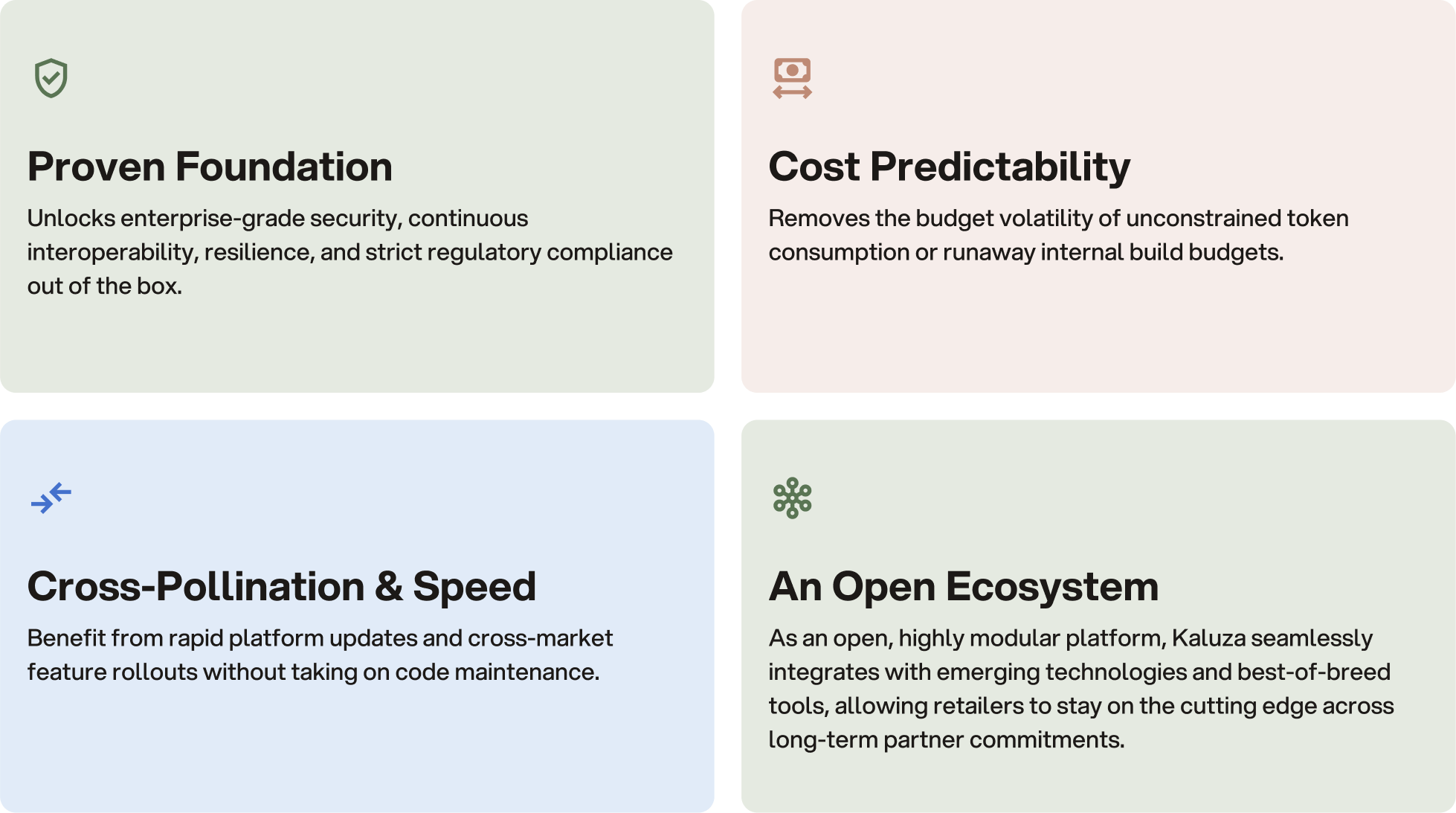
Kaluza provides the ideal middle ground, acting as the operational coordination layer between legacy energy systems, customer data, and modern AI tools.
Why Kaluza is the Ideal Foundation
Leaving the heavy operational foundation to Kaluza frees internal teams to concentrate on what creates true market advantage: delivering exceptional, differentiated experiences for energy customers.