
Europe has the technology to lead the energy transition. So why isn't it moving faster?
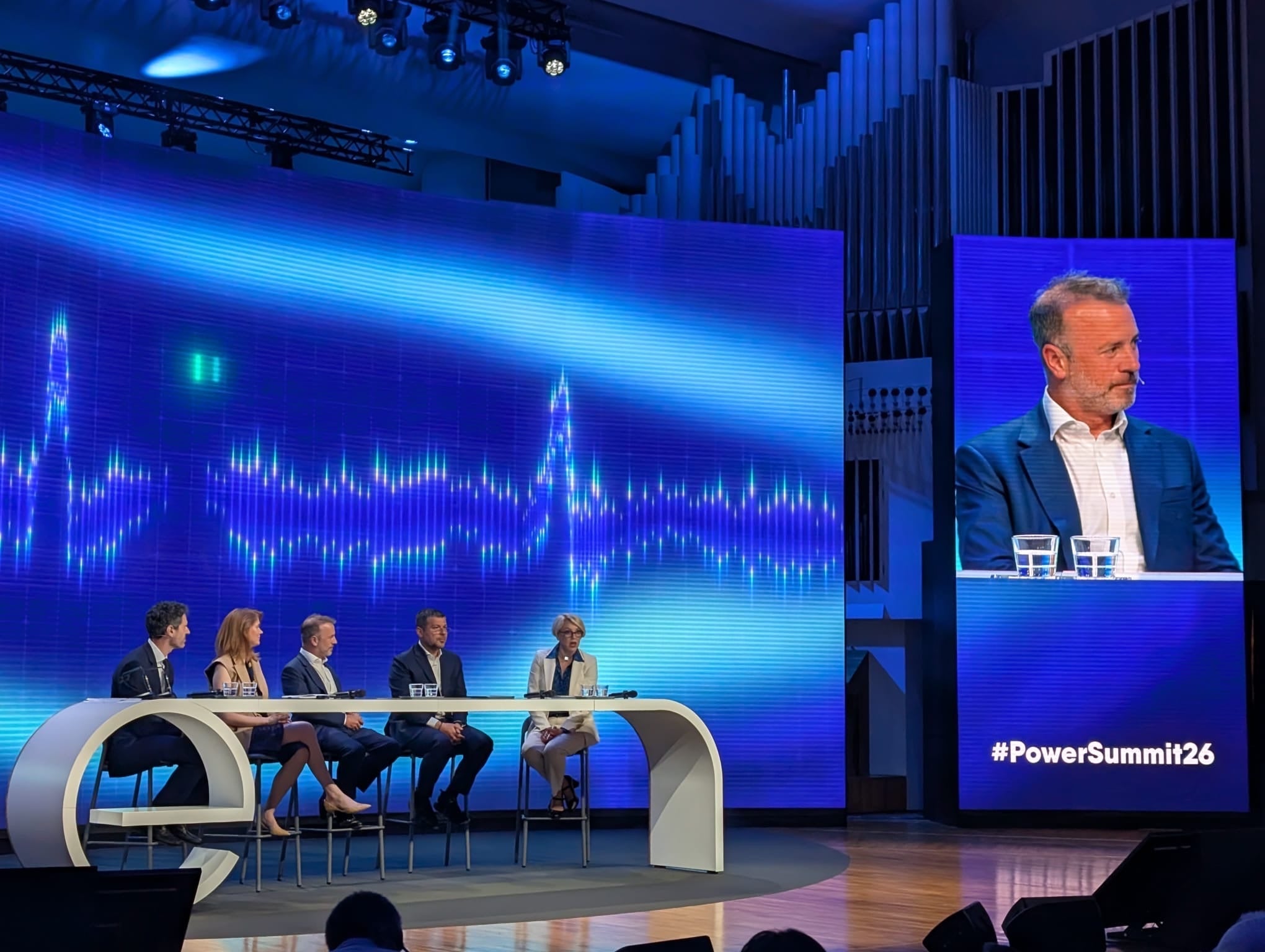
We spent two days at the Eurelectric Power Summit in Helsinki, in conversation with senior energy leaders from across the globe. Here's what stayed with us.
Finland is a country that knows how to win. It just claimed its fifth ice hockey world championship. It has been ranked the happiest country on earth for eight consecutive years. And it has the second highest per-household heat pump penetration in the world. There is something instructive about a nation that pairs genuine optimism with a relentless bias for action. It felt like exactly the right place to ask a hard question: why is Europe's energy transition moving slower than it should?
The ambition gap: why pace is now Europe's biggest energy challenge
Fifteen million EVs are already on European roads. Heat pump rollout is accelerating. Dynamic tariffs are becoming mainstream. The complexity hitting energy retail is not a future problem, it is one the industry is facing right now.
On the main stage, our CEO Stephen Fitzpatrick put the challenge directly to the audience: Europe has the technology and the talent. What it is short of is the willingness to commit at the speed and scale the moment demands. That is a harder problem to fix than a technology gap. It requires boards to make calls before every question is answered, and organisations to choose a direction and build toward it, rather than running cautious pilots while the window to get ahead of the market closes.
The utilities shaping European energy over the next decade are making those decisions now. The ones still running the same pilots in 2027 will be following someone else's lead.
The data is clearer than the politics
Jan Rosenow from the University of Oxford brought some numbers that reframe the whole debate. Electricity currently accounts for just 23% of Europe's total energy. The other 77% is still fossil fuels, burned primarily for heating, mobility, and industry. That is the real decarbonisation challenge, and electrification is the answer.
The efficiency case alone should close the argument: electrifying and powering with renewables could cut primary energy demand in half, and reduce wasted heat energy by two thirds. The barrier is not technical. Rosenow's research found that 90% of industrial processes are technically electrifiable with existing technology. The single strongest predictor of uptake is the ratio of electricity prices to fossil fuel alternatives. Get that ratio right, and markets move fast.
What is missing is not the technology. It is the orchestration layer that connects policy, price signals, grid infrastructure, and customer behaviour into something that works at scale. And the execution discipline to deploy it.
Most organisations are automating processes before they've redesigned them
The failure stories that came up most often in our roundtable weren't shocking. They were quieter than that: a vendor enabling a new capability before the business was ready for it, users trying to make sense of outputs they didn't understand, confidence eroding in ways that took months to repair. The technology had worked. Everything around it hadn't.
The pattern is almost always the same: new tools deployed on top of processes that were never designed to support them. Automating a broken process doesn't fix it, it just makes it break faster and at greater scale. The conclusion that kept surfacing: redesign the process before you introduce the tool. Get that right, then scale.
The future of customer service isn't no humans at all. It's humans in the right place.
Nobody at our breakfast roundtable was arguing for a fully automated energy retailer. The ambition is more nuanced than that, and more interesting. The organisations leading this conversation are focused on using AI and agentic capabilities to eliminate the interactions that don't need a human at all, routine queries, simple transactions, predictable workflows, so that when a customer genuinely needs support, a person is there to provide it properly.
The goal is not fewer people. It is better service, delivered at the moments that actually matter.
The question every energy retailer needs to answer right now
The distance between good intentions and real operational change in energy retail is not mostly a technology problem. It is a question of whether the foundations underneath, the data, the processes, the organisational design, are ready to support the ambition sitting on top of them.
That work doesn't show up in a strategy announcement. It takes longer, it requires redesigning things that have worked well enough for years, and the results aren't immediate. But it is what separates the organisations generating real returns today from the ones still preparing to.
